



All opinions and analysis are strictly my own
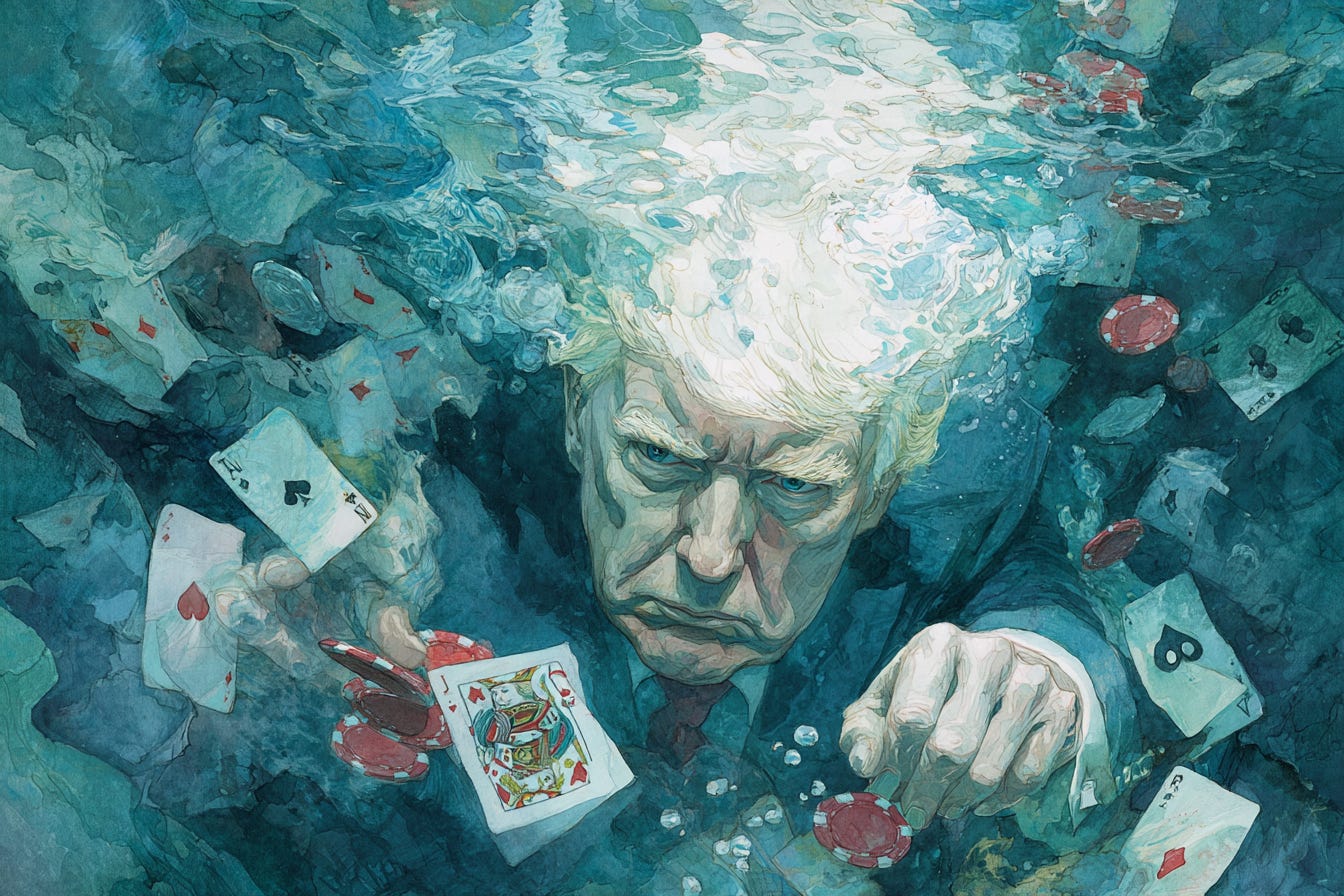
In an unprecedented diplomatic faux pas 13 long months ago, Donald Trump and JD Vance admonished Volodymyr Zelensky several times with the now infamous phrase “You don’t have the cards”.
Obnoxious antics aside, they were right, Zelensky was defending a maximalist position while neglecting the battlefield reality. Well, much has changed since this heated exchange, and while Zelensky’s prospects have scarcely improved, Donald Trump is now the one who is truly cardless in a crisis of his own making.
So far the US has failed to achieve a single meaningful strategic objective in Iran. Holding a weaker hand by the day, the US has not inspired a regime-change uprising, has completely lost control over the Persian Gulf, has lost billions in equipment and base infrastructure, and has isolated all allies except a global-pariah that has far more ambitious aims than itself.
So how did the most powerful nation in history end up with an offsuit 7-2 against an isolated and weakened Middle Eastern theocracy?
THE UPRISING THAT WASN’T
Early in the war’s infancy, Trump announced to the Iranian people, “when we are finished, the country will be yours to take”. Since then, he has announced multiple times that the war has been won, and while the theocracy has lost its ailing 86-year old Ayatollah along with numerous commanders, ships, and planes, it is far from defeated internally. Pro-regime voices have overtaken Iran’s city centers, massive rallies of hundreds of thousands have organized to praise the regime, and hundreds of potential dissenters are being rounded up in mass arrests. Anti-regime protests and riots have not resurfaced. If anything, it appears the population has nervously rallied behind the government as atrocities like the Minab Girls School bombing provide the impression that the foreign jets are not there to liberate them, but rather to bury their children in rubble and death. The country has also not fractured along ethnic lines, as the hawkish Foundation for Defense of Democracies enthusiastically predicted. Rather, a CIA-backed Kurdish rebellion dissolved before it began and there is no sign of serious Baloch uprisings in the Southeast or Azeri uprisings in the Northwest.
As detailed by resigned former head of US National Counterterrorism Center Joe Kent—who held the highest level of security clearance in the United States and was privy to critical war planning information—misleading Israeli intelligence was fed to the Trump Administration to push for this War. While impossible to confirm specifics, one can assume this intel played up the possibility of quick regime change and a popular uprising and downplayed the Iranian’s capabilities. Internally, US war planners grumbled and even publicly expressed doubts. Their pleas fell on deaf ears though as the crowd of sycophants, hawkish DC think tankers, warmongering pundits, and the close personal associates of Netanyahu, Jared Kushner and Steve Witkoff—who were cosplaying as nuclear arms negotiators—won out.
Despite over 10,000 airstrikes on Iranian territory in one month, the regime continues to successfully hit Arab, US, and Israeli targets across the region and has established a lucrative toll booth over the critical global lifeline of Hormuz.

The blame game has already begun among Washington’s top officials. On March 27, JD Vance’s office leaked to the press that the Vice President blamed Netanyahu in a bilateral call and lambasted him for pitching a quick and painless regime change war. The US Administration’s failure is so glaring that it is now grasping at a litigious definition of ‘regime change’ with Trump, Karoline Leavitt, and Pete Hegseth declaring that Ayatollah Ali Hosseini Khamenei being replaced with Mojtaba Khamenei—who is widely reported to be more extreme—actually matches the definition of regime change. With the IRGC still at the helm, civilian leaders still in place, and government institutions completely intact, this claim is as preposterous as asserting that the United Kingdom underwent regime change following the death of Queen Elizabeth.
ISRAELI ESCALATION CONTROL
The main barrier to peace is not the enemy, but the friend. As outlined by Joe Kent, the Israelis hold a near monopoly on escalation. Trump may have done a bit of hemming and hawing after Israel’s outrageous strike on civilian fuel depots in Tehran on March 7—which plunged a city of 10 million into darkness and blasted poison into their breathing space—but it’s clear the Israelis clearly bomb where they want, when they want. Over the last two weeks, Israeli strikes have consistently probed the boundaries of Trump’s hastily imposed war-conditions, hitting key infrastructure such as Iranian steel factories, nuclear energy facilities, and water reservoirs – baiting the Iranians to hit similar targets in the Gulf, which they have. To the Israelis, the potential destruction of gulf energy and desalination plants would be a positive development that sets back their Arab competitors by decades and brings the whole region closer to a coalition effort versus Iran. Trump, like Joe Biden before him, has opted for meaningless finger-wagging with Bibi Netanyahu. The President may castigate, admonish, and claim the US had no part in the next escalatory attack–but ultimately no military aid will be conditioned and no real consequences will be felt by the Israeli side.
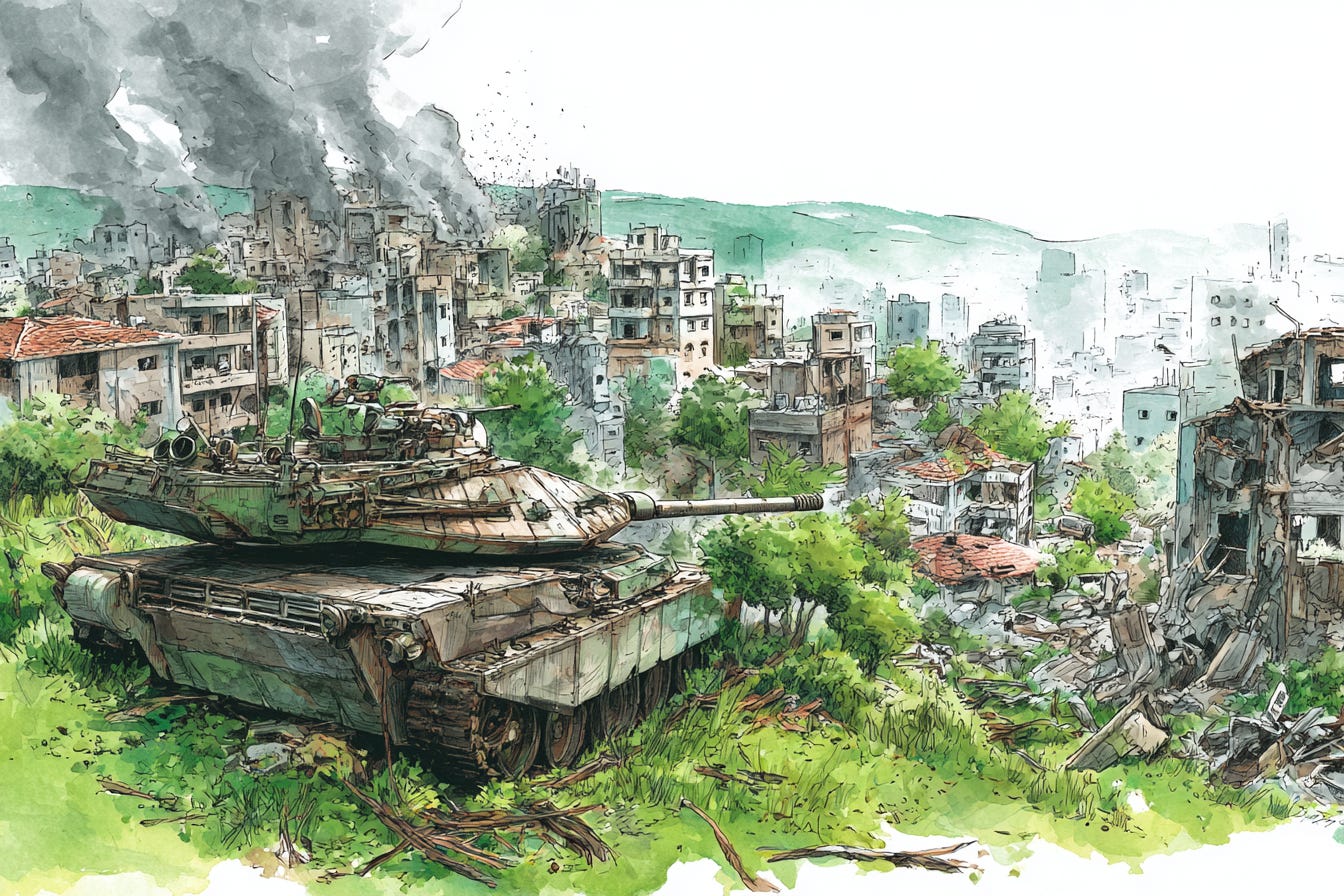
For Israel, the war is a must win, on all fronts. This is a key aspect most analysts are missing. Iran has set forth the condition that Israel not only has to cease their bombing of Iranian territory, it must also withdraw from Lebanon. For those who missed it, Israel has launched a massive offensive against Lebanon that has killed and injured thousands. Unlike recent border wars, Israel has vowed to remain indefinitely. On March 31, Israel’s defense minister pledged to occupy the country’s southern region as a “buffer zone”, all the way to the Litani River. The 600,000 Lebanese residents who have been forced out by Israel in recent weeks will not be allowed to return, and Israeli officials outlined plans to institute the '“Gaza approach”, decimating every residential, religious, and commercial building in the region.
This is not only a completely unacceptable proposal from Hezbollah and Lebanon’s perspective, but also kills the prospect of a deal with Iran. Hezbollah has endured an enormous cost to join in Iran’s defense on multiple occasions, which will not be forgotten by the Persian side. If Trump’s negotiation team can form actual talks and were miraculously able to reach some consensus with Iran on Hormuz, sanctions, a nuclear material handover, and a missile program resolution—there is still Lebanon to deal with. And from their advantageous position over Hormuz, and thus global markets, Iran is unlikely to make any serious concession while their Lebanese allies are in an existential battle.
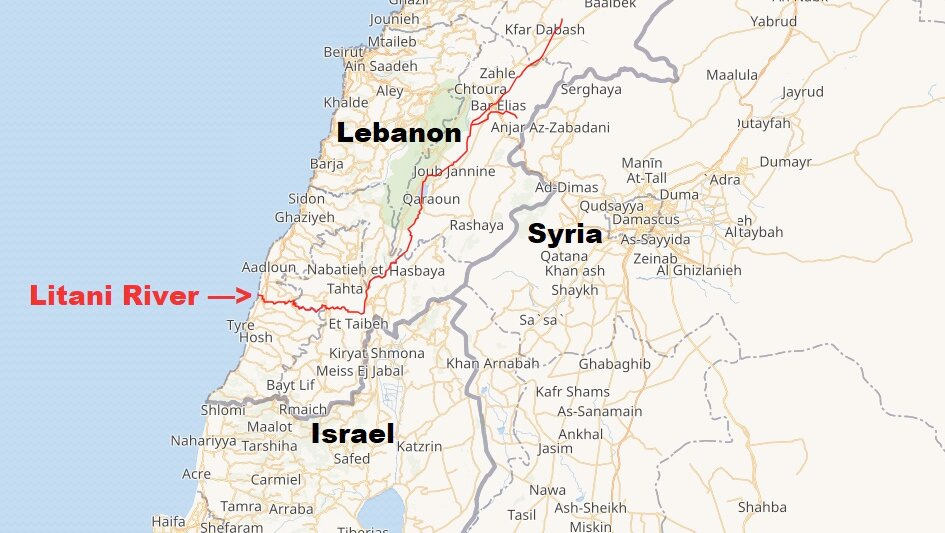
Israel also has no immediate reason to end a campaign in Lebanon, which has broad public support and offers the prospect of permanently expanding the settler-state into new lands. For Israel, the war must continue on this front, on the Palestinian front, and on the Iranian front. Thus, the Merkava tanks will continue pushing to the Litani, ‘decapitation’ strikes targeting Regime leaders will keep occurring in Iran, and civilian infrastructure in both nations will be attacked as America’s copilot takes the yoke and flies up the escalation ladder.
GEOGRAPHY
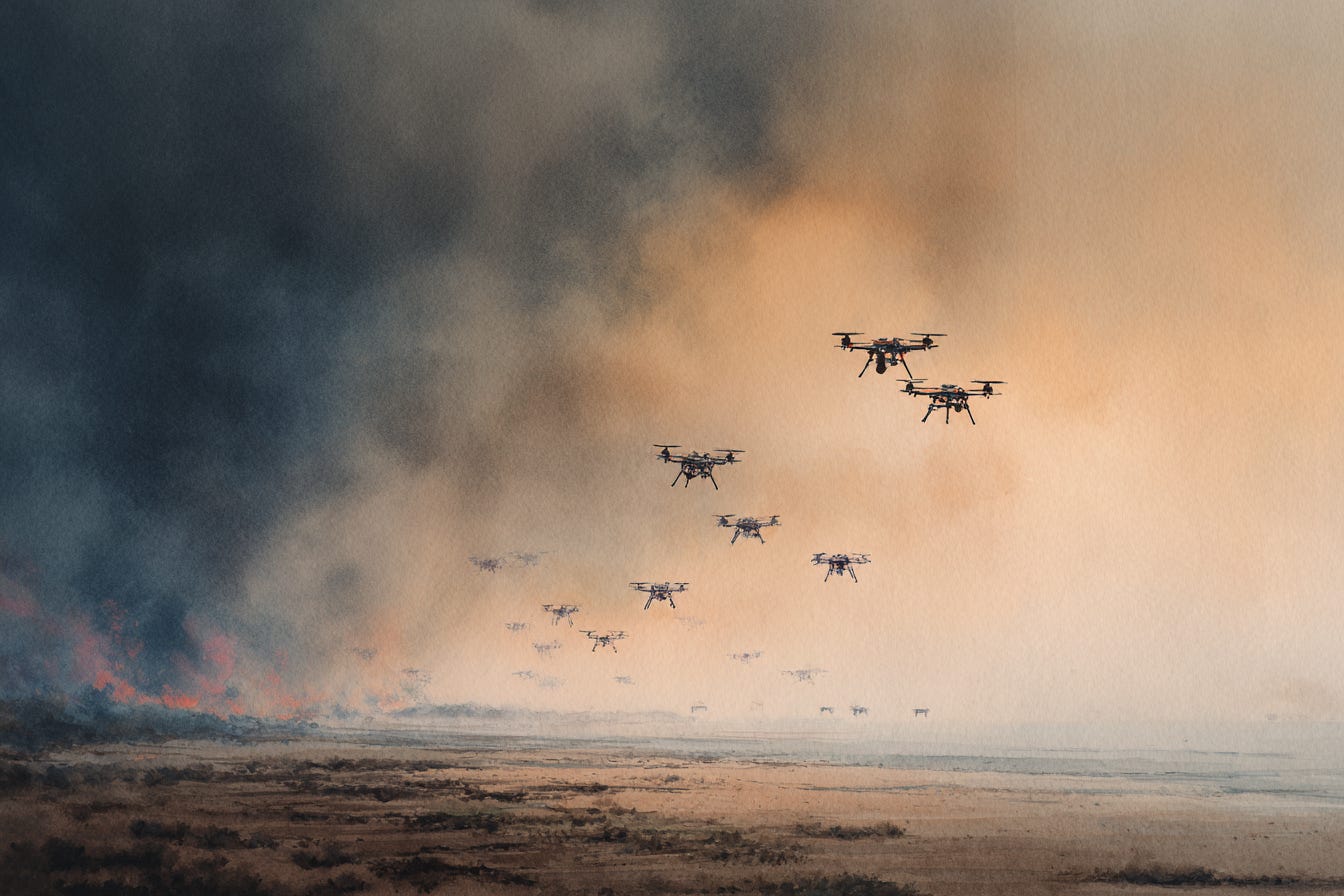
Trump has also been routed by the great decider of many of history’s wars—geography. Iran has a one thousand miles of coastline along the Persian Gulf and the Gulf of Oman, an area roughly equivalent to the US West Coast. While this area certainly has chokepoints, such as the strait of Hormuz, there is no way to guarantee control of the entire coast without a massive invasion force. Without ground control of this coastline, and a significant area buffering it, Iran can continue to target vessels with ballistic missiles, drones and small boats. If the US manages to completely knock out their missiles and boats, the affordable, mass-produced Shahed will more than suffice in a prolonged mission to hit commercial ships. Maritime shipping, and the insurance cartel underwriting it, relies on near certainty to maintain price stability. A 98-percent safety rating is not financially viable, and therefore, this key global transit zone will not be secure without a lasting peace agreement.
Western media has speculated endlessly on the seizure of Kharg Island, Iran’s key oil terminal, or a US landing at islands closer to Hormuz such as Qeshem and Larak. These options will also fail to guarantee maritime security as Iran will fire from deeper within their nation, and are likely to massively backfire as US ground forces contend with Iranian guerilla warfare and threats from FPV drones or “flying IEDs”. Even one point-of-view social media video of a terrified marine being hunted by an Iranian fiber-optic drone is certain to plummet US support for the war further in the abyss.
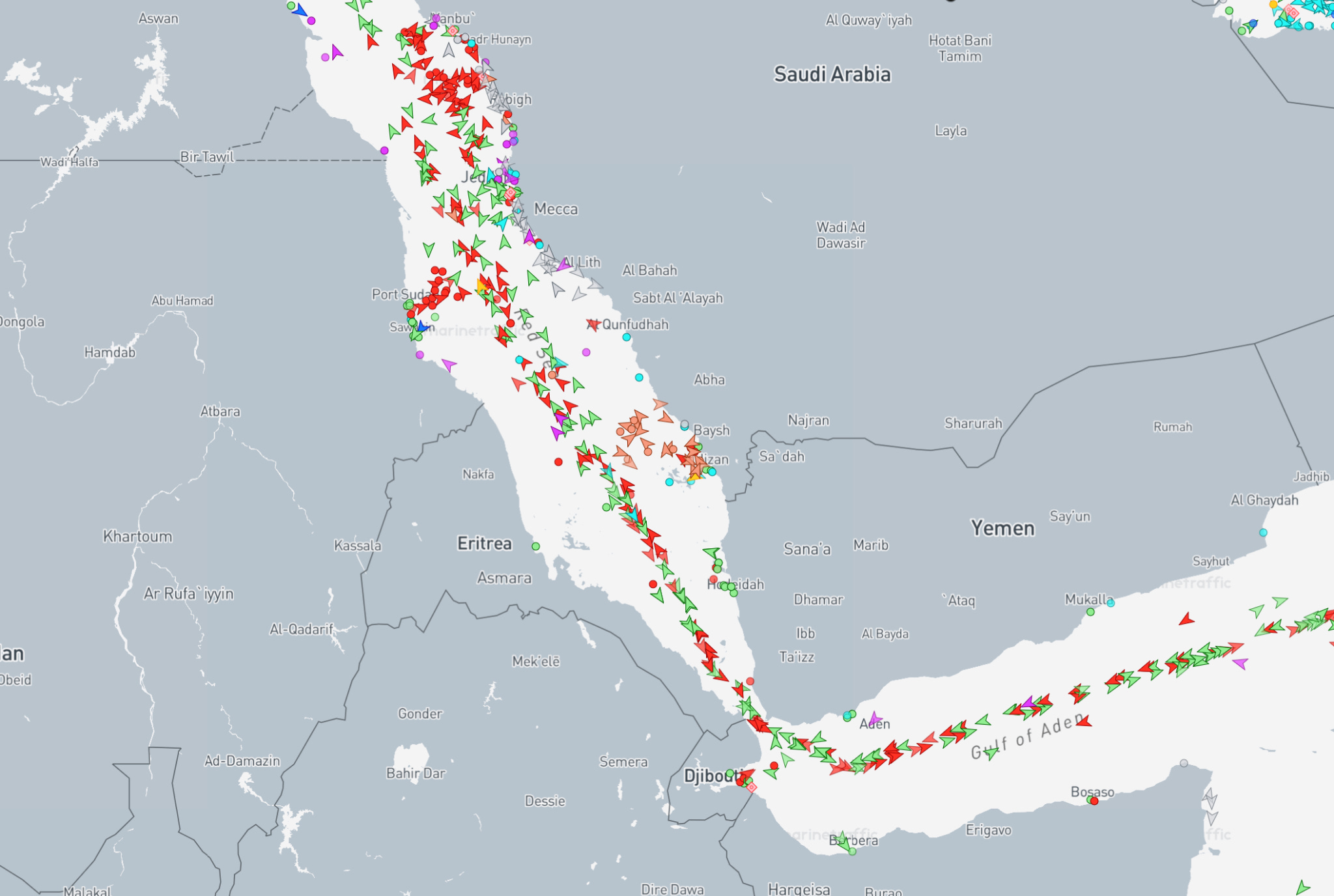
Further complicating the US war effort from a geographical perspective is the Red Sea’s Bab-el-Mandeb strait, a vulnerable narrow corridor that a significant amount of Middle Eastern oil output has been redirected through amid the Hormuz crisis. Alongside millions of barrels in oil, this strait moves about 20 to 30 percent of annual global container traffic. The Bab-el-Mandeb was significantly disrupted in 2023 and 2024 on behalf of Yemeni militia Ansar Allah “the Houthis”, who have now joined the war on Iran’s side. The Houthis have yet to target commercial shipping, but they have threatened to play this trump card if “escalation continues against Iran, Palestine, and Lebanon”. With two of Asia’s largest oil transit corridors all but closed, oil could easily rocket past $200/barrel.
NO (GOOD) WAY OUT
With the 31st Marine Expeditionary Unit and the 82nd Airborne in theatre, and a major announcement from Trump directly to the country due for tonight at 9pm Eastern, the prospect of a ground invasion appears to be a near certainty.
However, despite this high probability for escalation, there is a chance for TACO (Trump Always Chickens Out). Wall Street is betting heavily on this, as evidenced by the market rallies and oil slumps of March 31 and April 1.
Trump may lack any competence as a wartime commander, but he is still attuned to political vibes. The cacophony of sycophants and echo-chambers may not be sufficient to completely isolate Trump from how politically untenable a ground invasion would be. One scenario exists where Trump decides on a whim to end, or significantly wind down, the offensive campaign tonight. He could claim the strait is “open”—with the unspoken caveat that Iran now charges a toll on all traffic—and reiterate that military objectives were met and regime change has occurred. This would be a terrible result for the Gulf, who are left badly bruised and are now subject to an open-ended Iranian toll in the Hormuz, and would be a catastrophic result for the Israelis, who gambled on Trump decisively enacting Regime change and ending the nuclear threat once and for all. Netanyahu must now up the ante and do everything in his power to steer towards escalation; if Trump folds now, Israel may have just lost their last chance to co-opt the US military to take down their arch-enemy.